Scheduled for June 27-28 in Crawford, Nebraska, the Ninth Annual White River Wacipi is deeply connected to the region’s history of Native life. Angie White Taylor, president of the White River Wacipi organization, says that Cheyenne and Lakota Sioux Wacipis were held in this area before European settlers arrived in what is now northwest Nebraska. She explains that her ancestors traditionally danced in the valley at the headwaters of the White River, in the flatlands encompassing modern-day Fort Robinson, and at many other locations, including near the Niobrara River, Crow Butte, and Beaver Wall. Taylor emphasizes that, contrary to European misconceptions, these gatherings were primarily celebratory rather than precursors to conflict.
“Dancing is listening and moving in harmony with a drumbeat that reflects the sound of the human heart,” Taylor remarked. “Westerns on TV show ‘Pow Wows’ as preparations for battle, but Wacipis are primarily about joy, life, and celebration.
Taylor’s personal history, linked to Sioux and Cheyenne heritage, is deeply intertwined with Western Nebraska’s history. Historic Army maps designate parts of the northwest territory as her family’s tribal lands. Her family legacy includes her great-grandfather, Little Big Man, who rode alongside Crazy Horse, and her grandfather, Black Horse. Both men served as U.S. Army scouts at Fort Robinson and lived in the region for many years.
“This place is sacred to our people,” Angie explained one morning as she stood on a prairie-terrace above Crawford. “Right down there, where we now hold our Wacipi, is where my family camped and danced. My dad loved dancing. He taught me how to dance, both the men’s and the women’s footwork. I loved watching him. He’d look so solemn, then I’d catch a look in his eyes, and I knew he had moved into another world.”
Charles White, Angles’ father, attended the Red Cloud Boarding School in Pine Ridge, South Dakota. He became an exemplary dancer and soon represented the school in competitions and exhibitions across the country, including at New York’s Madison Square Garden.
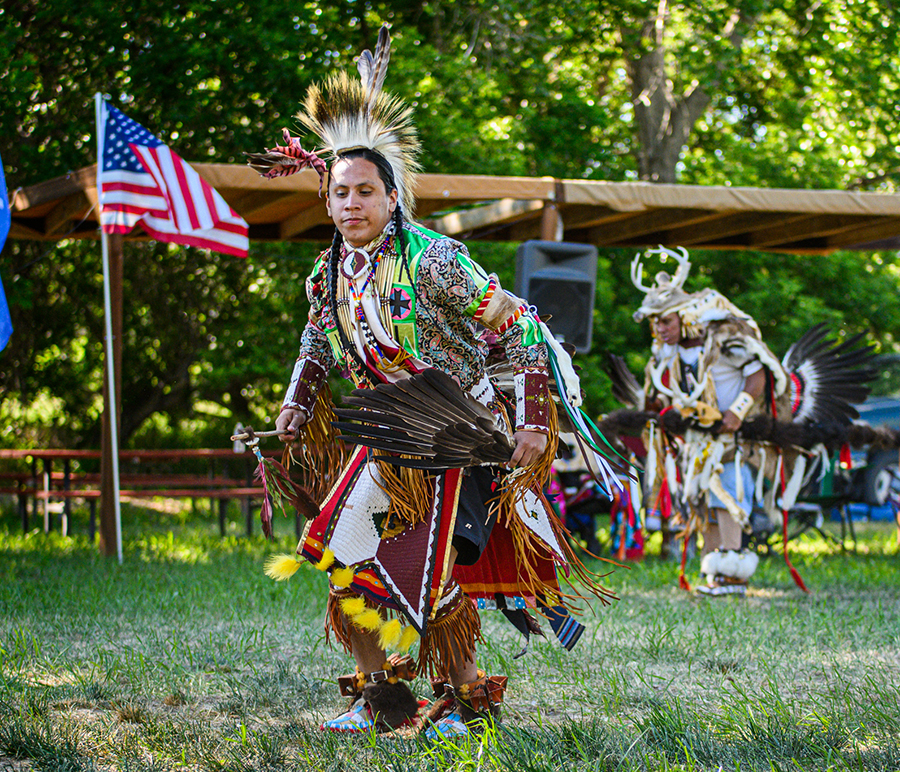
“He could dance so low to the ground that he could pick up a dollar bill stuck on the end of a stick about five inches tall. Two dancers would dance toward each other. They wanted to be the first to reach the stick, snag the dollar, and beat the others to the end of the path. It was a race, but they always had to dance the right steps and stay in rhythm. He looked like a bird. He had all kinds of steps that they don’t have today. In later years, I told people my dad looked like Fred Astaire. When he danced, he just floated, as if he wasn’t even touching the ground. At my Dad and Mom’s 50th anniversary, we talked him into dancing. He couldn’t get as low to the ground as he had when he was a boy, but he still danced so beautifully. He always wanted to be the best dancer. I learned to love dancing too, but not like he did.” Angie Taylor
Charles came by his dancing skills naturally. His father, Philip, was sent to the Carlisle Boarding School in Pennsylvania at age 7. He traveled overseas with the school’s dance troupe and danced before the Queen of England. Afterward, she invited the dancers to join her for “tea.” Angie said her Dad always smiled and held up his pinky finger whenever he told his father’s story.
One of several hundred dancers at the dedication ceremony of the Crazy Horse Memorial at Fort Robinson in 1934, Charles Taylor expressed his pride in his people’s skill to a young reporter in 1979.
“We must not forget to dance, to make each step important,” Taylor said. “The man in charge of the Boy Scouts asked me to teach his boys how to dance (as part of their American Indian Lore or Order of the Arrow merit badge program). I was happy to do that. If we don’t teach our kids how to dance now, they will soon forget.”
“It was fun to watch the boys dance with him,” Angie said. “Boys are sometimes a little wild, but not when Dad was teaching them. They were just fascinated. He was not only a great dancer, but he was also a great drummer and singer.”
In 1976, Victoria White, Angie’s mother, and Charley teamed with several friends to form the Yellow Hand Dance group to teach dance to young children across the region. Charles Taylor told a newspaper reporter that it had been about 20 years since “much dancing went on here.” The Yellow Hand Dance group was formed to change that. Their early success was reported in September 1978, with a full-page photo spread titled “Chief Red Cloud’s People Sing, Dance at Fort Robinson.”
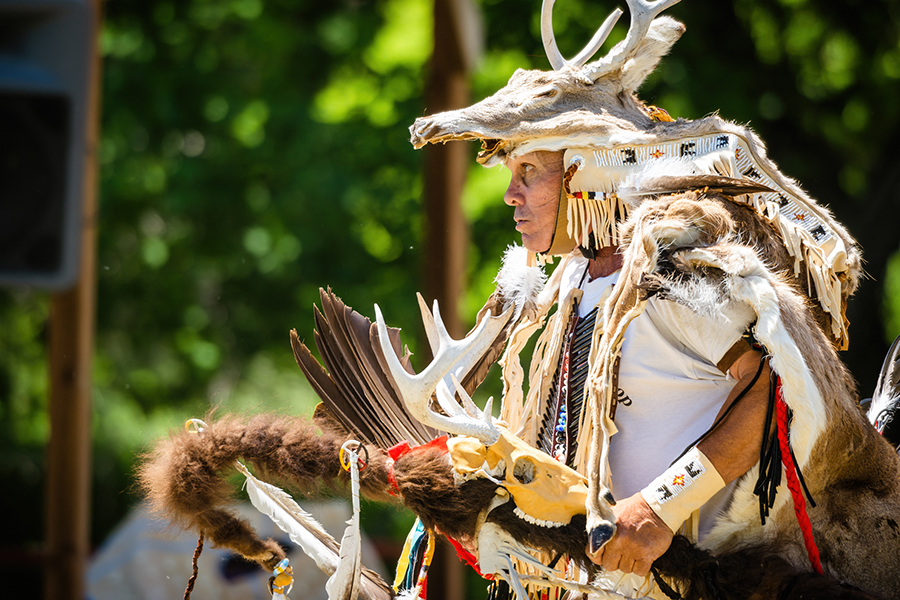
Even before the Yellow Hand Dancers were organized, newspaper stories in the middle part of the 19th century often featured “front-page spreads” on the Native dances in the region. Dancers used fancy footwork to celebrate the end of the “Potato Picking Season” in the Alliance Area, during “Indian Appreciation Days” in Gordon, events during the Oregon Trail Days in Gering, and beginning in 1886, at the Fourth of July celebrations in Crawford. In 1986, the first annual Oglala Nation Fair was held in Pine Ridge.
The Chadron City Council decided to include a Pow-Wow as part of their 1981 Fur Trade Days in Chadron. An article in The Chadron Record said the $3 admission fee for the event would be used as prize money for the expected 100 competitors. On July 22, 1981, The Chadron Record reported that “although the Pow Wow and Wachipi (sp) Contest was a success, with 60 entrants, it was not a success financially.” The Chadron Record also reported, “A Pow Wow during the 1982 Fur Trade is tentative at this time.”
It was twelve years later, in 1994, when “Pow Wows” were again included as a Fur Trade event. The Record announced on its front page, “A new event during the Fur Trade Days… the First Annual Pow-Wow to be held at the Dawes County Fairgrounds.” The article reported that the dance contest would feature “traditional and fancy for men and women, jingle dress, grass dance, and tiny tots.”
A February 1989 article in The Chadron Record announced the establishment of a “Chadron Native American Center” in Chadron. In April of that year, Chadron State College established “Native American Indian Days” to promote the importance of Native tribes and their culture in northwest Nebraska. The following year, a “traditional dinner and pow wow” sponsored by the White Buffalo College was announced as a highlight of the annual “Native American Awareness Days” at CSC. The Yellow Hand Dance Club “performed “Pow Wow dancing for entertainment” during both events.
The Chadron Schools joined Chadron State College in 1994 to sponsor the “Multicultural Looking Beyond Pow-Wows.” Tye Bissonette, a CSS senior from Pine Ridge who organized the event, was quoted as saying the pow-wow was held to “look forward for the sake of the children. We may be different colors, but we are all living for the same thing.”
A seven-year-old boy competing in the second annual Indian Pow-Wow and competition at Scottsbluff’s Western Nebraska Community College that year agreed. He told reporters from the Scottsbluff Star Herald that this was the “most fun ever” and that learning to dance was “really important.”
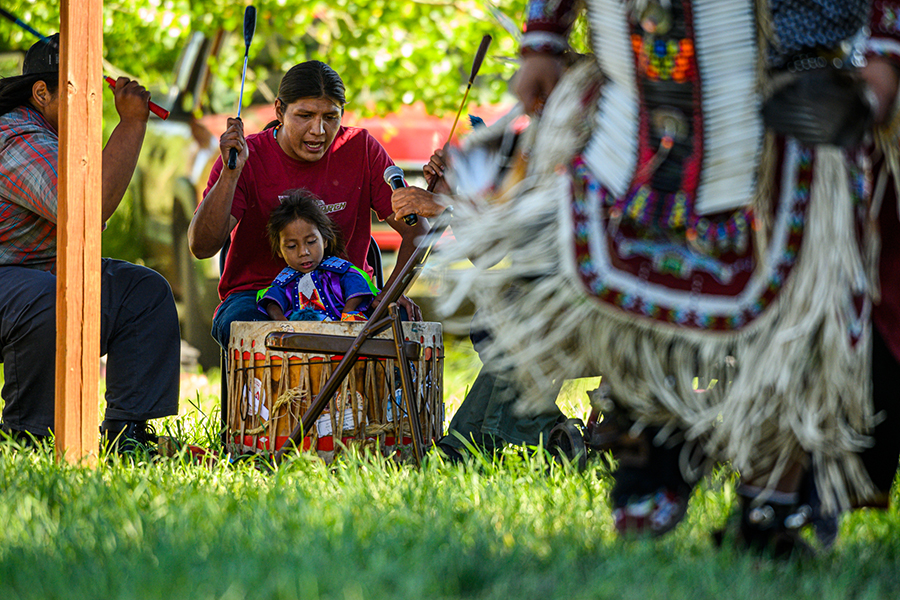
The Yellow Hand Dancers were the main attraction at the dedication of the Agate Fossil Beds Visitor Center in June 1997. The following September, Gold Medalist, Billy
Mills, attended the Community Pow Wow in Chadron and delivered an inspirational speech about his life, not only as a gold medalist but also as a young Native American boy from Pine Ridge.
As interest in “Indian Dancing” grew, Fort Robinson State Park officials contacted Angie Taylor to ask if a “PowWow” could be organized at the Fort. Angie told him that was a man’s job and contacted her brother, Bob White.
“Jim Lemmon really wanted a Pow Wow at the Fort. In 1999, we organized an event that explained PowWows.” Bob White said. “ A few dancers demonstrated steps and taught others how to dance, and there were some vendors there. Then, the next year, we organized a full PowWow. My wife, Joyce, and I helped it get started by taking out a loan on our house. Then the donations started coming. We got grants from different places. People like Donna Brown helped us with our 501 (c). Barton Kreider made sure we had the right kind of insurance. Everyone stepped up to help, and it worked. It worked very well.”
An article in the May 2000 Chadron Record said the event was the first gathering “at Fort Robinson to celebrate Native American history” since the 1935 dedication of the Crazy Horse and Levi Robinson Memorials.
A June article of the Crawford Tribune reported that 3000 spectators visited the PowWow and the nearby Soldier Creek Mountain Man Rendezvous that year. In addition, dozens of artists from across the nation brought their crafts to the event. By the end of the month, it was decided to hold a second event in 2001. The White River Run, which debuted in 2000, was also rescheduled and became a parallel event for the next 25 years.
At the 3-day “Intertribal Gathering” in 2001, an event described as “an event of healing,” sixty competitors from seven tribes competed. Members of the Northern Cheyenne tribe of Montana hosted the third annual Fort Robinson Intertribal Gathering in 2002. Special ceremonies were held in remembrance of the Cheyenne who “sacrificed their lives in the 1879 Cheyenne Outbreak (Breakout) at Fort Robinson.” The event was moved to June in 2003. Each year, the wacipi focused on honoring either a group of individuals in the community or a single person. Memorials were held to honor others. Many times, individuals received Cheyenne or Sioux names of relatives or of those who had affected their lives.
Brylee Allred Carlin said she returns to the Crawford Wacipi as often as she can. In 2007, Angie Taylor honored Brylee during a naming ceremony, at which Brylee received the name “Chasing After Horses,” Victoria White’s Cheyenne name.
“I didn’t know Victoria White, Angie’s mother,” Brylee said, “but I knew how important she was to my family. When they tied that eagle feather in my hair, I was sure I would always be connected to her. I was only four, but that day will forever be etched in my mind. That day, I knew I would always respect Victoria and her people because my name was Brylee Marie Lee Allred “Chasing After Horses.” Those are the moments that often change who you are.”
Throughout the first 15 years of the event, photographs captured the spirit, skill, and effort that went into the event. Carefully crafted clothing, jewelry, and accessories mimicked those worn a hundred years ago by dancers who celebrated bison hunts, spring, and life. Bob White and his wife continued to organize the event. Angie Taylor said she was just Bob’s helper but was “pleased to be there to help.”
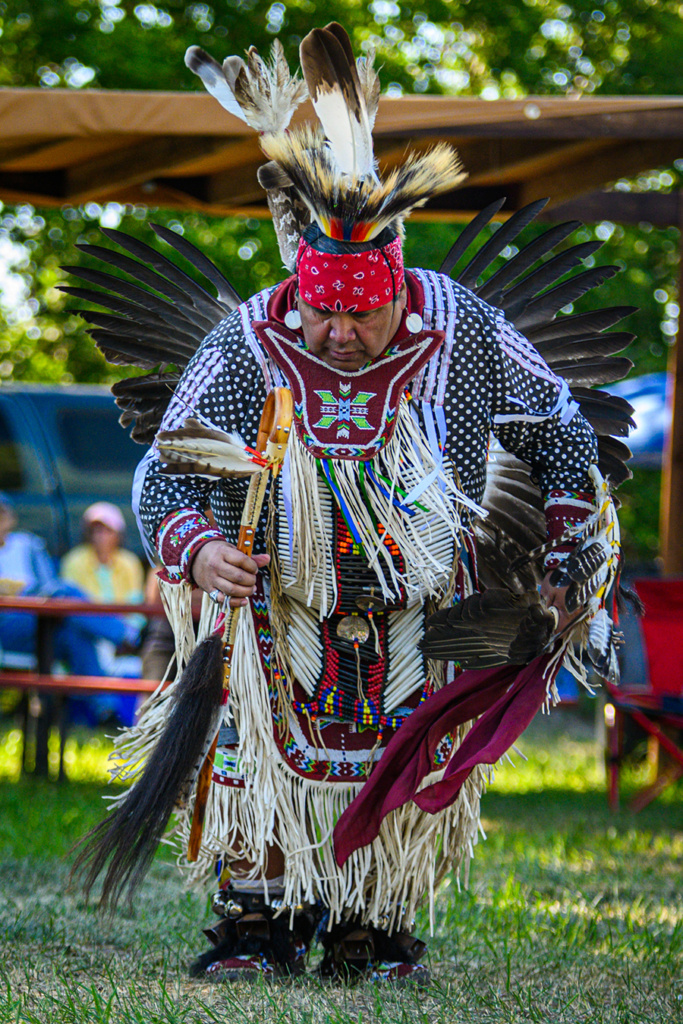
Owners of the High Plains Cookshack were among the vendors at the June 2010 event, as were members of the summer staff from the Hudson Meng Research and Education Center. Nearly 100 dancers from eight states attended the event.
“Across the years, when we held the Wacipi, people spoke with us. They talked about the history of our people and their connections to that history,” Angie Taylor said. “Every year we learned more about our people in and away from this community.”
As a precursor to the 2011 Intertribal Powwow, the Crazy Horse Memorial Highway was dedicated with ceremonies at Fort Robinson. Over the years, the annual Crazy Horse Ride came through Fort Robinson shortly before the Intertribal Gathering.
The 2015 event honored Crawford’s Fire Department, and Auggie Taylor, an Army Veteran, received a spiritual name from his uncle, Bob White. The most popular event over the years was the Tiny Tots dance, followed closely by the “Potato Dance” or the “Apple Dance,” which requires dancers to hold an apple or a potato. pinned between their foreheads as they perform intricate footwork to the increasingly fast pace of the drum beat.
The Intertribal Gathering was deemed as one of the “most successful events” in the region until 2016. That year, two weeks before the event, it was canceled. No one was sure the event would ever continue in the region.
However, in 2017, Angie Taylor, at the urging of Crawford City clerk Virginia Hamaker, organized several Crawfordites into the “White River Wacipi” non-profit organization. There was no dancing that year, but many gathered to hear traditional songs and to build an arbor from pine boughs and limbs donated by rancher Richard Hoffman. Mayor Dave Nixon told a Chadron Record reporter that, “from a cultural and
historical perspective, providing the committee with a location for a permanent arbor structure and location was a no-brainer.”
“We still have a long way to go. We’re doing this on a shoestring,” Taylor told the reporter in 2017, “but we can make it work.”
Angie laughed when she admitted no one had brought tape measures to the wacipi site the day they built the arbor, but they just used ropes and stepped everything off. “We were like our ancestors. We found ways to solve the problems.”
Two of the visitors helping to build the arbor were Pauline and Madeline Garnier, descendants of Little Bat Garnier, a well-known scout and interpreter at Fort Robinson who was killed on the streets of Crawford. Pauline Garnier told a reporter that the day filled her with happiness because it brought a piece of history and culture back to Crawford. Those in attendance quickly agreed.
The arbor was built, and the dancers were standing ready, when the military honor guard, consisting of several local Veterans, ringed the dance field at the 2018 Wacipi.
Local newspapers from across the region made the event their front-page story and dedicated entire pages to the imagery that filled the Wacipi grounds at the park. Dave Nixon was there, presenting an educational program on flint-napping. The smell of Auggie Taylor’s fry bread drifted across the park. Firefighters who spent most of their day celebrating the dedication of their new fire hall stopped by. Dancers performed intricate footwork to drum music that bounced off the buttes. The event was deemed “a great celebration.”
In the years since that 2018 Wacipi, the event has endured many struggles. COVID-19 lowered attendance in 2020. Financial issues plague the event. But every
year, private donations, grants, and the determination of Angie Taylor, her family, and her board members have kept the event alive.
In 2025, the event faced extinction, but new board members, brimming with enthusiasm, have moved it forward. The Wacipi grounds have been cleaned. Thanks to donations and dedication from board members, grass has been planted and watered. Posters grace windows across the region. Angie and her husband have made several trips to the Pine Ridge Reservation to invite participants.
“I’m so excited about this year,” Angie, who will celebrate her 87th birthday on June 21, said. “We have a young, enthusiastic board that isn’t about to give up. All these years, we’ve danced in this region to celebrate. This year, the celebration will mean more than it ever has.”
–Article by Moni Hourt; photos by Brandon Davenport