
By Kerri Rempp, Northwest Nebraska Tourism Director
Throughout history, generations have learned about those who came before through song, stories and art. Nowhere are those traditions more imperative than in the Native American culture. Plains Indians who populated what is today known as Northwest Nebraska passed their traditions from one generation to the next.
Today, artist Joe Pulliam continues the custom of his ancestors as he creates ledger art. Ledger art takes its name from the source of paper Native Americans began to use as European settlement moved westward. As tribes came into possession of ledgers, ink and pens, their artists expanded their craft, which had primarily consisted of using bone fragments and earth pigments to paint on shields and robes.
“This really represented the next step in art,” Pulliam said. “They were adapting to new materials.”
A native of Pine Ridge, Pulliam worked as a graphic designer for 10 years before learning about the connection of his people to ledger art after being introduced to the medium by Nebraska artist Daniel Long Soldier.
“The historical aspect of ledger art drew me to it,” Pulliam said during a recent stint as the artist-in-residence at the Mari Sandoz High Plains Heritage Center in Chadron.
When Pulliam discovered his great-great-uncle, Amos Bad Heart Bull, had been a prolific ledger artist, it cemented his decision to carry on the tradition. Bad Heart Bull’s father served as the historian for the Oglala Lakota and after becoming a scout for the U.S. Army, which included time at Fort Robinson, Bad Heart Bull followed in his father’s footsteps detailing the history of his people. According to Northern Plains Reservation Aid, Bad Heart Bull created 415 ledger art drawings on used ledger pages over the course of 20 years. The drawings depict Oglala Lakota life before 1856, followed by the conflicts with the Crow from 1856-1875 and the Battle of Little Bighorn, in which his father fought.
Artist Joe Pulliam answers questions about his ledger art in front of a ledger art creation done by his great-great-uncle, Amos Bad Heart Bull.
Bad Heart Bull’s original pieces were buried with his sister, Dolly Pretty Cloud, but were documented by photographer Helen Blish, said Laure Sinn, of the Mari Sandoz High Plains Heritage Center. Staff at the center discovered Blish’s book in the center’s archives – a gift to Mari Sandoz at some point – and Bad Heart Bull’s connection with Northwest Nebraska and created the current gallery showing “Native American Legacies.” The show, which runs through Dec. 13, includes reprints of many of Bad Heart Bull’s ledger art pieces, as well as original creations by Pulliam.
Using Blish’s work as a focal point, the show also features Honoring Quilts donated by Roxie Puchner and a display calling attention to missing and murdered indigenous women. Blish herself has connections to the region, as her father, William, was assigned to work with the Oglala Sioux on the Pine Ridge Indian Reservation while employed with the Department of Interior’s Indian Bureau, according to History Nebraska. After graduating from college in 1922, Blish taught English in Gordon for a time before returning to her native Michigan. When it came time for her to write her master’s thesis, she began looking for examples of Plains art, an endeavor that led to her 1934 manuscript “A Photographic History of the Oglala Sioux” featuring Bad Heart Bull’s work.
Pulliam said research is a key part of his ledger art as he finds ways to preserve the culture and history.
“I’m exploring new ways to portray history in a modern light,” he said.
A piece he calls “Indigitized” represents Native American’s struggle with identity as they always have “one foot in history and one foot in the present,” Pulliam said. “Warrior Society” depicts fierce defenders in Oglala Lakota history who were also among the most generous people of the tribe, proving they were equally valuable in times of peace as they were in war. Pulliam hopes his art inspires the return of those values to society while additionally calling injustices to light, as he does in another piece inked on an 1892 Sheridan County land deed, to represent government-ignored treaties.
While his great-great-uncle used present-day ledgers for his creations, Pulliam scours the internet, antique shops, thrift stores and yard sales in search of ledgers to use in his work.
“The search is always on,” he said.
Pulliam is also active in social justice issues and is a supporter of the White Clay Maker Space, an effort to provide economic sustainability to Lakota living in the area. A recovering alcoholic, Pulliam said while the maker space’s business-aspect is important, he is more focused on empowering himself and his people through art and providing the healing he finds in the creative process.

This ledger art drawing of the Battle of Little Big Horn was done by Amos Bad Heart Bull.

This ledger art creation by Joe Pulliam is produced on an 1897 Sheridan County land deed.

Joe Pulliam shows a visitor to the Mari Sandoz Center a book of ledger art pieces by the Cheyenne Dog Soldiers, some of the premier Native American ledger artists.

On the left, Joe Pulliam’s Warrior Society ledger art creation is contrasted with his work on the right, drawn on a sheet of music. “When I look at music, I see art,” Pulliam said.

Joe Pulliam served as the artist-in-residence at the Mari Sandoz High Plains Heritage Center in November.

In addition to Amos Bad Heart Bull’s ledger art, pieces by Joe Pulliam are also on display until Dec. 13, 2019, at the Mari Sandoz Center.
By Kerri Rempp, Northwest Nebraska Tourism Direcor
Say the name Walter Reed and one thing likely comes to mind – Walter Reed Army Medical Center, now known as the Walter Reed
National Military Medical Center. Half a country away, the medical center has treated hundreds of thousands of soldiers since its inception, a fact most of the population probably already knows.


But there’s a connection to Northwest Nebraska and the medical center’s namesake, Walter Reed, with which many might be unfamiliar. Dr. Reed, who earned his medical degree at age 17, was commissioned in the US Army Medical Corps in 1875 and spent five years serving on the American frontier. For three of those years, 1884-1887, he was stationed at Fort Robinson. His time there and a pharmaceutical collection of items from that period in the region are part of the new “Hindsight is 20/20” exhibit at the Mari Sandoz High Plains Heritage Center.
Dr. Reed went on to become a major and served as the curator of the Army Medical Museum in Washington, D.C., and a professor at the Army Medical School. He discovered how both typhoid and yellow fever are spread. While at Fort Robinson, however, he was treating soldiers and area settlers, including Old Jules, famed pioneer and the subject of the book “Old Jules” written by Mari Sandoz. As the story goes about Old Jules, he suffered a broken ankle while digging a well and was found by Fort Robinson soldiers 18 days later.
As Dr. Reed examined his foot, black and green with infection, Old Jules reportedly threatened to kill the good doctor if he amputated.
“My orders are to amputate. But your wish to die in one piece shall not be ignored. And it would be just like your particular brand of damn fool to pull through,” Dr. Reed replied.
As Dr. Reed left Fort Robinson to continue his illustrious medical career, the local paper bid him farewell with this missive: “We doubt if Fort Robinson will ever contain a physician as affable and accommodating as the outgoing doctor has been, not only to the soldiers but settlers as well.”
The “Hindsight is 20/20” exhibit chronicles Dr. Reed’s life alongside a display of pharmacy items, including pill bottles and medicines. The section of the exhibit dedicated to Dr. Reed is just one of 20 collections being showcased through March 20. With the start of 2020, Laure Sinn and Holly Counts said it seemed appropriate for the Sandoz Center to look backwards and used the opportunity to display a variety of exhibits that depict everything from early Native American life in the region to agricultural advancements and law enforcement.
“It’s a way to show off a lot of the smaller collections of the region,” Counts said, noting that over the years many individuals have approached them about displaying their collections but didn’t have enough to fill the center’s full gallery.
A flintknapping display, for example, reveals the tools used and skills exhibited by early humans in their effort to communicate and survive. Another is dedicated to the Elite Theatre in Crawford, owned by Timothy and Georgianna Higgins in the early 1900s. The couple first operated a saloon and added the theatre in 1909. When Mr. Higgins died in 1912, it is believed that Mrs. Higgins became the first woman in the U.S. to own and operate a moving picture theatre, according to research provided by the Crawford Historical Museum. The theatre showed its first talkie in 1930, and Mrs. Higgins retired not long after that, but first constructed a new theatre building.
Other exhibits are dedicated to the White River Mill, which was operated by the Hall brothers until 1915, the Native American Church, formed in the 1870s with a Pine Ridge Chapter blessed by Pope Paul VI in 1975, and to The Rev. George Philip Bechtel, who served the local German population and Native Americans on the Pine Ridge Indian Reservation from 1929-1943.
There is also a collection of Mari Sandoz’s music and letters, including one from a reader of her book “Slogum House.”
“The book is a curiosity. It is so rotten and so putrid it stinks. Yet, having been an inmate of the Insane Asylum, due to the fact that I did every thing I could think of to prevent its being published, you might pardon me. Your characters are well chosen and you would be amazed if you knew that I am quite well acquainted with several of your characters,” the reader wrote. “You are a wonderful woman since you wrote a manuscript which causes the entire world to act like insane fools,” the letter writer continued and implored Sandoz to “Write a clean story, Mari Sandoz, which will help instead of destroying.”
The author responded to the 1944 letter explaining that she began writing the story as Hitler came to power and was attempting, through fiction, to visualize the methods an individual might use to dominate the world or a region. Sandoz refused to send the letter writer a copy of her book as she didn’t want it in the hands of a reader “unable or unwilling” to seek out its purpose.” She encouraged the woman to “learn to look at the world with a little more objectivity, seeing it as an observer, not as the personal center, you might find life less complicated and defeating, and certainly more fun.”
The Sandoz Center will host speakers and demonstrations in conjunction with the show and also is introducing a new feature with its exhibition of the “Hindsight is 20/20” show. A plus-one exhibit is on display at the show-sponsor Bean Broker Coffee House and Pub in downtown Chadron. The collection of photographs by Dwight Kirsch were taken in 1939 for a planned MGM movie based on Sandoz’s book “Old Jules.” The movie never went into production, however, as producer Irving Thalberg fell ill and had to scrap the project.
“When we first came to town, we thought, we have this great gathering spot in downtown Chadron,” said Dave Feddersen, who purchased the Bean Broker with his wife, Paige, a year ago. “We want to be Chadron’s living room, where the doors are open and everyone is welcome.”
The pictures of Nebraska’s beautiful landscapes are starting to attract attention from the business’ customers, including one local rancher who realized one of the historic photos was taken near his parents’ homestead, Feddersen said.
“I think people are starting to look at it and appreciate it. I think it’s engaging. People enjoy it and they like to see variety here,” he said.
The plus-one exhibit at the Bean Broker, which was put up in December and will run through the end of March, is dubbed “Foresight is 20/20.” Feddersen hopes to continue the concept in other ways once the show is over, possibly through other Sandoz exhibits, or with other artistry depicting Northwest Nebraska for visitors to enjoy when they stop.
“It’s a way to partner with the Sandoz Center, the college, and others to drive awareness about the resources we have in this area,” Feddersen said.
If You Go
By Kerri Rempp, Northwest Nebraska Tourism Director
The murder of an Army scout, the Cheyenne’s run through the buttes after fleeing Fort Robinson, and railroad camps and tent cities that boomed with the coming of the railroad all share one thing: geography.
Northwest Nebraska is rich in history; the story of the West unfolds in Dawes and Sioux counties, from Native American heritage to the era of fur-traders and homesteaders. Nearly three dozen historical markers provide historical context for the people and places that shaped Northwest Nebraska.
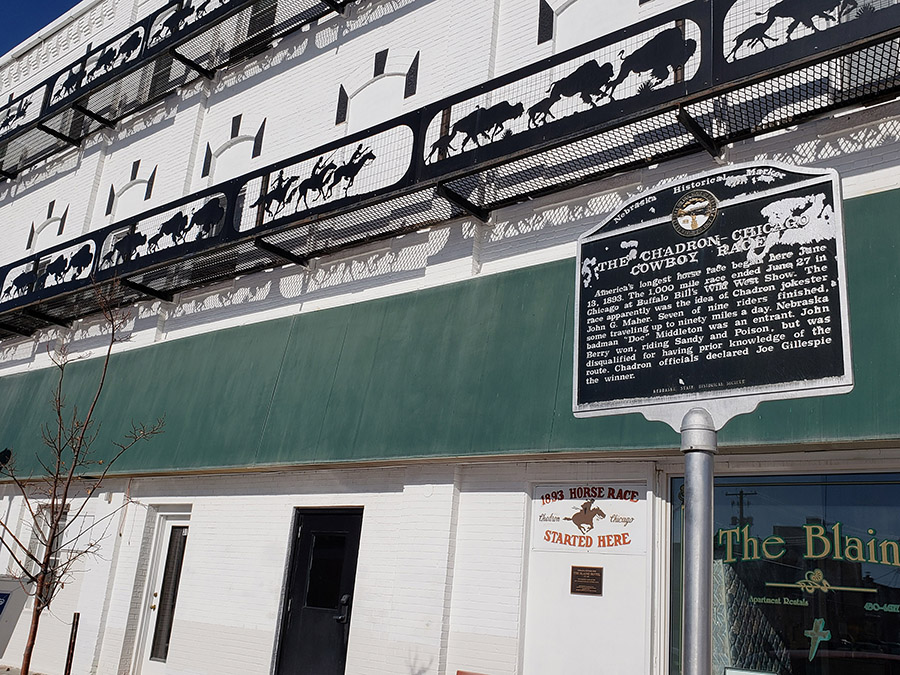
Before the West was carved up by homesteaders and the free range fenced, Native American tribes walked the land of Northwest Nebraska and during the fur-trade era, many conducted business with the traders. James Bordeaux opened his Indian trading house in the mid-1840s near what is today the Museum of the Fur Trade. Bordeaux’s trading house was once attacked by Crow warriors, who were eventually driven off by friendly Sioux Indians. He traded the Indians’ buffalo robes, furs and ponies for guns, powder, blankets and whiskey for nearly three decades in Northwest Nebraska.
But as westward expansion surged, disputes over land erupted. In September 1875, the Allison Commission met with thousands of Sioux Indians under a lone cottonwood tree near present-day Whitney. The commission members hoped to convince the Native Americans to part with the Black Hills, but negotiations failed. While the Council Tree or Treaty Tree died decades ago, its general location is still marked along Old Highway 20.
The story of the Native American people continued in Northwest Nebraska as more settlers arrived, the military established outposts and tribes were assigned to dedicated “agencies,” where they were to live. A few years after the Allison Commission failed in its negotiations, a band of Cheyenne, led by Dull Knife, fled a reservation in Oklahoma, seeking to return to their homeland in Wyoming and Montana. Nearly 150 of the Cheyenne were captured and imprisoned at Fort Robinson, refusing to return to Oklahoma. In January 1879, several of the younger Cheyenne Warriors used smuggled weapons and broke out of the barracks, fighting a running battle across the Fort’s parade ground, eventually reaching the White River, scaling the nearby cliffs and escaping. The Cheyenne evaded troops for 12 days but were discovered hiding along Antelope Creek Jan. 22. The outbreak resulted in the deaths of 64 Cheyenne and 11 soldiers.
Other Native Americans worked with the military, such as Baptiste “Little Bat” Garnier, who served as Chief of the Fort Robinson Scouts. Garnier’s father was French-Canadian, but he was raised among his mother’s Sioux people, earning a reputation as one of the best interpreters and big game hunters in the Rocky Mountain Region of the Nebraska Territory, according to “Fifty Years on the Old Frontier” by James Cook. Little Bat took part in General George Crook’s Black Hills Expedition, worked as a scout with Col. Merritt’s 5th Cavalry and was acting as a military interpreter during Wounded Knee when fighting broke out.

He was shot and killed Dec. 16, 1900, in a Crawford saloon by local bartender James Haguewood. After being shot, Little Bat stumbled into the street and was taken into a nearby building, where he died, Cook wrote in his book. His life and death are paid tribute with a plaque on the side of what is today known as the Corner Bar, where the fatal shot was fired. Haguewood was acquitted on a plea of self-defense.
Little Bat’s death and interment records read that he was “brutally shot while wholly unarmed and without cause or justification.”
The City of Crawford itself is recognized with a historical marker, having its start as a tent city in 1886. Named after a soldier at Fort Robinson, the town served as an important supply depot for the military outpost, and a center of entertainment for the soldiers stationed there. The historical marker telling the city’s story is located at the site of the Visitor’s Center at the junction of Highways 2/71 and 20.
Crawford isn’t alone in its historic status; the village of Harrison is also recognized with an official state marker. Originally established as a railroad camp in 1884, the town was initially named Summit thanks to its elevation of 4,876 feet. It remains the highest town in the state today.
Just west of Harrison was the Coffee Siding. Cattle ranching was king in Northwest Nebraska, and one of the largest cattle barons, Charles Coffee, constructed a railroad siding between Harrison and Lusk in order to ship cattle to Chicago and avoid Wyoming’s higher freight charges. Agriculture remains a key industry in Northwest Nebraska but trucks have taken over what was once the railroad’s domain.
The complete list of Northwest Nebraska’s historical markers can be found at http://discovernwnebraska.com//museums/. Plan a day or weekend trip this winter to visit as many of them as possible and push those winter blues aside by enjoying Northwest Nebraska year-round.
By Kerri Rempp, Northwest Nebraska Director of Tourism

Mention the word library, and most folks think of nothing more than shelves of books. But as the world has changed, so too have our local libraries. The abundance of books and the importance of the written word remains, but libraries have become centers for makerspaces, educational classes, access to computer programs and the internet.
In Chadron, the public library hosts yoga classes, virtual reality events, craft sessions and more. In October, the Chadron Public Library and the Library Foundation reached a milestone with its sixth annual Trading Stories Native American Film Festival. Traditionally held during the annual Fur Trade Days celebration, the library this year moved the film festival to October as a standalone event.
For three days, the library screened documentaries and films, hosted speakers and offered traditional Native American food to pay tribute to the often-forgotten stories of the people who called this region home before European settlement. Films such as “Neither Wolf Nor Dog” and “Tiger Eyes” and the discussions that accompanied them provided opportunities to connect across cultures and served as a reminder that we all share the same human experiences.
Filmed on the Pine Ridge Reservation, “Warrior Women” depicted the contributions of mothers and daughters during the American Indian Movement of the 1970s. Documentaries like “Rumble” brought the connection across generations as it detailed the important influence Native American musicians have had on the music to which we listen.

“Ohiyesa, The Spirit of an Indian” told the story of Charles Eastman, who cared for injured Native Americans at Wounded Knee. The film was so popular during the festival organizers ended up showing it three times instead of once, as intended.
Trading Stories films were screened for more than 200 people, with many individuals traveling to Chadron from the Pine Ridge Indian Reservation, Hot Springs and Rapid City, South Dakota.
For anyone with a desire to learn more about Native American culture, history and its impact on life in the Pine Ridge region, the annual Trading Stories event is a great place to start.
But don’t wait until next year’s event to visit the Chadron Public Library. The library has an extensive Indigenous Peoples of North America Collection. Designated by a red sticker or the IPNA code, the materials include Native American music, films and books.
And if you’re looking for something else, it’s likely you’ll find it at the library as well. With nearly 79,000 items in its collection, the Chadron Public Library is sure to hold something of interest for anyone. Staff also host frequent events, including preschool story time each Thursday at 10:30 a.m., a Game/STEM Club on the second and fourth Mondays of each month at 6:30 p.m., and Lego Club on the first and third Mondays of each month, also at 6:30 p.m. The Friends of the Library also opens the annex next door to the library during the second weekend of each month with great bargains on books of every genre.
The Chadron Public Library is planning a Halloween Party for Nov. 2 from 2-4 p.m. and will host a Christmas party later in the year.
Also coming up is the Innovation Studio Maker Fair. The Chadron Public Library has been a host site for the Innovation Studio Maker Space since July. The library’s six months are almost up, however, and the makerspace stations will be moving on. To celebrate the creativity inspired by the presence of the Innovation Studio equipment, the staff will host a Maker Fair Nov. 9 and are inviting everyone who created items in the makerspace to bring their creations to display.
The Chadron Public Library is open from 10 a.m. to 8 p.m. Monday through Thursday and from noon to 5 p.m. Friday and Saturday. Library cards are available to residents of Dawes, Sioux and Sheridan counties, as well as residents of Hemingford. For more information, contact the library at 308-432-0531, stop by at 507 Bordeaux Street or visit chadronpubliclibrary.com.
Northwest Nebraska Tourism Influencer Tour
Shaley Ham – Western Fashion Influencer and Blogger
They call Nebraska a flyover state, but to be honest, the only reason it might have that name is because of the incredible view Nebraska delivers from above! I had the opportunity to explore all over Western Nebraska in June, and as my first visit to the Cornhusker state, it’s safe to say that the incredible history and scenery is anything but “plain.” With a tagline of ‘Honestly not for everyone,’ Nebraska provides unique adventures for all types of people to experience.
First stop on my Western Nebraska adventures was one that took me up in the clouds to get the most scenic view of Scotts Bluff National Monument. My hands-on experience with High Plains Hot Air Balloon Company in Mitchell, NE was the first time seeing a hot air balloon with my own two eyes! As if the balloon itself wasn’t a work of art, but the spectacular view it provided in the air was like nothing I had ever seen.
Don’t Miss: Mitchell, NE is set to host the U.S. National Hot Air Balloon Championship August 12-17th! What an incredible opportunity to see upwards of 75+ balloons taking the skies!
Like I previously mentioned, you expect Nebraska to be all flat plains, but the numerous landmarks surprised me with their unique geological features as well as abundant history! A few miles east of Gering you will find yourself at the base of Chimney Rock, of the most notable landmarks among the Oregon Trail travelers. It didn’t take very long in the visitor center there to figure out vast amounts of emigrants that hauled their wagons past this unusual shaped rock, as well as the family of rattle snakes that happened to stay and remain to call the area home.
Of course we couldn’t leave Scotts Bluff County without visiting its namesake landmark, the Scotts Bluff National Monument. We ended our day with a pleasant drive to the peak, or at least as far up as you can go, driving through tunnels carved out of the side of the sandstone. On the east side, you are able to see out to Chimney Rock on a clear day; the west side delivered one of the best sunsets I have seen in a long time. They weren’t lying when they named this place the “Gateway to the West.”
The next day, we took a drive an hour or so north, and next thing I know we landed on the Moon—better known as Toadstool Geological Park. Make sure you apply your SPF for a day trip out here, because the unusual rocklike formations and winding trails throughout will have you exploring for hours! We decided to take the mile long trail loop that rewarded us with sandstone formations of fossil footprints that are millions of years in the making.
On our last day touring Western Nebraska, we made a stop at a site with a little more of a modern twist to it: Carhenge. Yes, you read that right and it’s exactly what you’re thinking. You might be thinking of Stonehenge. Well, the arrangement of cars in Alliance, Nebraska recreated this landmark with a sight that will leave a lasting impression. Take yourself on a walking tour around these cars stacked on top of one another, and don’t forget to take a minute to sign your name on the designated one to the north of the installment!
Nebraska’s state slogan of “It’s not for everybody” has gotten some national recognition, but if I’m being honest, Western Nebraska has a little piece of paradise for anybody! Plan your next vacation to the western side of the beautiful Cornhusker state and I will promise you won’t be calling it a flyover state anymore.


Chadron’s Classics In The Park Car Show will be the host for the 2019 Vintage Chevrolet Club of America Mile High Region 43rd Middle West Meet June 10th through the 14th. The Vintage Chevrolet Club of American is a national nonprofit organization dedicated to the preservation, restoration and enjoyment of Chevrolets and GMC cars and trucks.The Club has over 80 regions and chapters including clubs in Europe.

The Mile High Region is headquartered out of Denver and has members in five states who will be coming to Chadron for the meet. The classic cars and trucks are restored to the way they came out of the factory when they were new. Engines, bodies, and accessories are the way they were when the vehicle was sold new. The classic cars will start rolling in to town Monday June 10, they will have a welcoming party that night at the Best Western motel. The registrants are being encouraged to visit the area on their own Monday.

The group expects as many as 85 of the classics to attend this summers event in Chadron which will include several banquets, a car show on Tuesday and cookout hosted by the Chadron Classics In the Park Car Show and cruises in Chadron and a plaque driving tour to Fort Robinson State Park. The car show and cookout on Tuesday will be at Wilson Park in the afternoon. The public is welcome to see the vintage Chevrolets and GMC’s in the park and can join the Vintage Chevrolet Club members for the cookout following the awards program at 5 p.m.. The cookout is free to the members, with a small charge to the public. This will be a good time to welcome them to Chadron and talk cars with them.

The group chose Chadron as its 2019 host site after learning of the Chadron Classics In The Park Car Show. A member of the Vintage Chevrolet Show attended the show in 2018 and was impressed with the show and Chadron and organized this years show with the help of Chadron’s group. Besides the beautiful line of cars and trucks the community will see the group will make a significant contribution to the economy over their four day stay.
By NaKaya Fester, Museum of the Fur Trade Director

The Museum of the Fur Trade, located 3 miles east of Chadron, opened its doors in 1955. “This was the first museum within a hundred-mile radius and the area people were very proud of it.” A privately funded museum and a truly unique place to visit, it covers over 500 years of history and the entire North American continent.

In 1953, Charles Hanson had the idea of a museum about the fur trade. There have always been misconceptions surrounding the fur trade, fostered in part by literature, movies, and television. Charles wanted to help dispel these as well as “provide a tangible reality to the images fostered by generations of academics who had concentrated on the biographies and geography of the fur trade.”
Charles’ vision for the museum included “the story of the fur trade across North America from the time of the first European contact to present day and should be located at the site of an actual trading post.” He examined sites in five states before deciding on the Museum’s current location.
The “actual trading post” Charles was referring to is that of James Bordeaux who, at the time of construction in 1837, was an agent of the American Fur Company before going into business for himself.
The southwest design of the museum was to be “a tribute to the Hispanic people who were among the first traders in the area.” It houses over 8,000 items pertaining to the material culture of the Fur Trade. The collection “represents every type of object exchanged by Europeans and Americans with the native people of North America.” More specifically it contains over 300 firearms or firearm fragments comprising of arms captured at Wounded Knee, personal weapons such as those belonging to Kit Carson and Tecumseh and the largest and most complete collection of Northwest guns in the world. The largest portion of trade occurred in textiles of which we have many examples of point blankets, southwest blankets, and fabrics. Items of note in our textile collection is the oldest point blanket made in 1775, and 5 cotton fabric samples chosen by William Clark specifically for trade with the western Indian tribes.

Through correspondence Charles was able to obtain several varieties of seeds originating from the upper Missouri tribes. Other varieties were collected directly “from Indian People.” These seeds are replanted yearly in the museum’s heirloom garden allowing visitors to view a variety of plants grown by various tribes.
Through the years staff has been fortunate enough to conduct research worldwide. This has enabled us to provide thousands of photographs to individuals, institutions and publications including Reader’s Digest, National Geographic and the Smithsonian. It also assists with the continued growth of our collection and publications.
The museum publishes a Quarterly journal containing articles of various aspects of the fur trade. Other publications include 20+ titles consisting of, the Hawken Rifle, Buckskinners Cookbook, When Skins Were Money: A history of the Fur Trade and numerous sketchbooks. The museum’s most recent undertaking has been the Encyclopedia of Trade Goods. This 6-volume set contains information about the material culture of the fur trade. Each is highly illustrated, and between 400-500 pgs. There are currently 3 volumes completed, each of which has won national recognition.

Along with the Museum’s publications and Heirloom seeds, the museum shop has available numerous fur trade related titles. We also have reproductions of collection items and a few original pieces. Accompanying these unique gifts are jewelry and other craft pieces made by Indians.
Admission started at 25¢ with children and members being free. Not much has changed; children and members are still free along with active service members and admission has increased to $5. Today’s visitors are welcomed warmly, offered an introductory video and given a map of the museum depicting the location and a synopsis of our galleries. It also guides visitors through our outside exhibit where they not only see a furnished reconstructed Bordeaux Post, warehouse and heirloom garden but are offered the chance to see inside an 18-foot tipi and a scenic view pretty similar to what visitors to the post would have seen almost 200 years ago. We strive to be a place that people continue to enjoy visiting whether they are “Mountain Men” or families driving along highway 20.
Learn more about the Museum of the Fur Trade.

Four-and-a-half hours from Denver, far from the crowds and soul-crushing traffic, lies an oasis steeped in Old West tradition. It’s the far northwest corner of Nebraska, at the tail end of the 100-mile-long Pine Ridge land formation, and it’s fast becoming savvy Front Rangers’ newest get-out-of-Colorado destination. Here, you’ll find over 200 miles of trails for hiking, biking and horseback riding that fans out from two main towns: Chadron, a hip college hamlet, and Crawford, more traditionally cowpoke. Basecamp at either spot (or in one of the 15 public campgrounds nearby), and you can explore 169,000 acres of public lands, including two state parks, the Nebraska National Forest, the Oglala Grasslands and the southernmost ridge of the Black Hills. The land here remains largely unchanged from the pioneer days—meaning you can escape a Colorado one might argue is changing too fast in exchange for Nebraska where the trails and campgrounds are relatively vacant, the hiking and mountain biking are on par with with Front Range classics, and the towns are still humble little down-home places where the customer—not the dollar—is king.
Hiking
You’ll be shocked by the hiking in northwest Nebraska. Here where the prairie meets a desert landscape that feels like Fruita, you’ll find canyons, creeks, sand hills and those iconic sand-and-clay formations made famous by the region’s northern neighbor, The Badlands. The trails at Fort Robinson State Park wind through buttes with names such as Lover’s Leap (4,163 feet, where legend says two young lovers from warring Native American tribes, who’d been forbidden to marry, leapt to their deaths); Trooper Trail (10.5-miles long and locarted in the Soldier Creek Wilderness Area and accessed from Fort Robinson); and the Norwesca Trail, a 5.2-miler that loops from top to bottom of Nebraska’s Pine Ridge in Chadron State Park. But Chadron local and Northwest Nebraska Toursim Director, Kristina Reeves—a native of Colorado—loves the three-mile Bison Trail, in Toadstool Geologic Park, which passes through a variety of landscapes including badlands, grasslands and Ponderosa Pines; the 1.4-mile-long Steamboat Loop Trail, in popular Chadron State Park; and the six-mile Spotted Tail Loop, at The Cliffs, Nebraska National Forest where abundant wildlife (wild turkey, white-tailed and mule deer) abide. Get thee to any of these, says Reeves, and you’ll forget that your favorite hiking was ever among the crowds in Colorado.
Biking
Mountain biking in Nebraska? Absolutely, says cyclist George Ledbetter, a former newspaper editor who has been riding bike trails in the region for decades. To reiterate: There are 200+ miles of riding in the 169,000 chunk of public lands that surround the towns of Crawford and Chadron. They include singletrack MTB trails through pine forests, across prairie grasslands and up steep buttes and narrow slot canyons. There are also plenty of “gravel grinds” down country roads with stunning views across wide expanses of prairie, the picturesque White River valley and the open horizon of the unique Nebraska Sandhills. Road riders, meanwhile, can rack up miles on well-maintained, broad-shouldered east-west Highway 20, a main route for many cross-country bikers, or north south on Highway 385, the Gold Rush trail to the Black Hills of South Dakota.
Ledbetter, a diehard mountain biker and gravel grinder, loves to churn along through the landscape on these three multi-facted rides: The Spotted Tail Trail, off of King Canyon Road, goes through open meadows and stands of pine trees. Parts of the trail area were badly burned in 2006, so don’t try this one at midday in summer. The 16.7-mile Buttermilk Loop (a gravel grinder), traces county roads and state highways. It features great views of the Pine Ridge forest and Crow Butte and crosses some Badlands terrain. And The Cliffs, located on the Nebraska National Forest, southeast of Chadron, offers multiple opportunities for mountain biking. Trails go up (south) to Table Road, with alternative routes for the return trip, including a thrilling ride down King Canyon. And get here on the third weekend of September for the 15-mile-long Twisted Crawdad Cameco Mountain Bike Race, sponsored by the Chadron Community Recreation Program in collaboration with Chadron State College. It’s a fall classic.
Horseback Riding
The U.S. Forest Service spent big money developing riding trails in the Pine Ridge area back in the early 1990s, according to Crawford local and lifelong horseman Don Huls. They start at various trailheads in Chadron State Park, Nebraska National Forest and Fort Robinson State Park, and they wind hundreds of miles through rugged, picturesque terrain. The Pine Ridge trails cruise through vast, open meadows, soaring buttes and stunning rock formations, that bring you back to long-gone days of the frontier. You’re on your own with your horse—one operation does “nose-to-butt rides,” says Huls, but it detracts from the experience. Each June, Huls and a group of local “outriders” (a term borrowed from the “good old trail days,” says Huls) host Ride the Ridge, with one- and two-day events. You head out with other horsemen, ride most of the day, and return to crazy-cool accommodations. Fort Robinson State Park boasts shady campgrounds for horse lovers and non alike, with electrical-hookup sites and primitive sites. Put your horse up for the night in one of the newly remodeled horse barns. There are plenty of lodging options here that can accommodate two to 25 people. Try one of the 1909 enlisted men’s quarters, or the former officers quarters (read: cabins) that date from 1874 to 1909. All feature kitchens, baths, living rooms and bedrooms.
No horse? No problem. Trail rides are offered all summer at Fort Robinson State Park and Chadron State Park. Want more? Our Heritage Guest Ranch north of Crawford rents horses you can ride on your own, offers lessons and leads trips on its property.

NITTY GRITTY
Sleep
For information on the 15 both primitive and non-primitive campgrounds in the Chadron-Crawford region, head to discovernwnebraska.com/campgrounds. To find Bed and Breakfasts in the area, check out the comprehensive listing at Northwest Nebraska High Country (nebraskahighcountry.com). For a sleep experience that’ll snub all of the #vanlife geeks, stay in a hike-to mobile sheepwagon, “the marvel of practicality and efficiency,” on grasslands and timbered ridges, with the proprietors of the RuJoDen Ranch (sheepwagonhideouts.com/ecosetting.htm).
EAT
Chadron’s Bean Broker serves food all day but their baked goods are to die for. Try the daily special, which uses location-grown herbs and local produce. The Snack Shop in Crawford, serves breakfast and lunch seven days a week. Hit up Q’s Dairy Sweet in Crawford for Texas-style barbecued beef, or hit the locally owned D & S Market in Crawford for small business offerings, which are always throwback and cool. Chadron State College students hit Wild’s Bar and Grill, for the fresh-cut locally rasied ribeye, or the Ridge, for its cowboy-size chicken fried steak. Cowboys, families, and other Crawford locals rave about the burgers, fries and ice cream, all devoured in an open-air setting, at Staab’s Drive-In (it’s only open in the summer, though). And for all the meat-lovers, EJ’s BBQ in downtown Chadron is sure to quench that craving.
Chadron’s Fur Trade Days is a throwback to the ERA when fur trading ruled the area—an important part of Nebraska’s history. Compete in the World Champion Buffalo Chip Throw and watch the parade, complete with a canoe race in Chadron State Park. It’s always the second full weekend in July. For more information, visit furtradedays.com.
KYLEE ODENBACH
Northwest Nebraska Tourism Intern
Wednesday, August 1, 2018
Hi, my name is Kylee Odenbach and I spent the summer interning at Northwest Nebraska Tourism. Northwest Nebraska holds some great treasures that everyone should experience at least once in their lifetime! Let me tell you a little bit about the great riches of Northwest Nebraska.
1.You can’t beat the great people of Northwest Nebraska.

Nebraska, in general, is known for harboring great, caring people. After working for Northwest Nebraska Tourism, I will vouch for that 110 percent. The people that I have met while interning here have been incredible. Business owners around Dawes and Sioux County have been friendly as could be! People around this area are constantly providing assistance and offering their time, free of charge. Make sure to visit Northwest Nebraska because you can’t beat the people, so you may as well join them.
2. Northwest Nebraskans have fun.

People in Northwest Nebraska like to have fun, and if there isn’t anything organized going on, they create their own fun. There may not be as many activities going on in Northwest Nebraska compared to New York City, but the people still always have a good time. I have found that people around this area sincerely enjoy each other’s company and visits. Hiking, biking, rodeo, boating, concerts, or just sitting on a front porch in conversation are a few ways Northwest Nebraskans entertain themselves. Heck, if you come out for Fur Trade Days, you can even throw a fresh buffalo chip at the World Championship Buffalo Chip Throw! Come to Northwest Nebraska if you’re itching to have some fun!
3. The work ethic is real!

The work ethic of Northwest Nebraskans is one-of-a-kind. The people here have their fun, but they also work twice as hard as they play. Whether it’s a local business owner, a rancher, a farmer, or a family business, Northwest Nebraskans know how to grind. I think that’s what gives this part of the state such a great reputation. The people I have met in Dawes and Sioux Counties work extremely hard, which in my experience translates to progressive and productive community. This work ethic is contagious and inspired me to work even harder in life.
4.Who knew Nebraska had such beauty and history?

While working for Northwest Nebraska Tourism, I had the opportunity to see some of the unique beauty that Nebraska has to offer. I visited Chadron State Park, the Cliffs Trailhead Recreation Area in the Nebraska National Forest, and, of course, Fort Robinson State Park. Chadron State Park is beyond gorgeous and offers so many activities for tourists! Horseback riding, swimming, biking, hiking, camping, and many other great hobbies are available at the park. The Cliffs Trailhead almost gave me a stomach ache just because I’m scared of heights, but it’s very impressive to see! It has some amazing trails for hiking. Fort Robinson is my favorite Northwest Nebraska attraction. The history that took place at the Fort is beyond belief. Today, Fort Robinson offers hunting, hiking, camping, kayaking, and many other recreational activities, not to mention the gorgeous butte views.
Northwest Nebraska Tourism has taught me that Nebraska is a great place to live and visit for countless reasons. Visit Northwest Nebraska to meet some great people, see the beauty of Nebraska, have some fun, and be inspired by the amazing work ethic they have to offer!
Chadron and Crawford Community Survey Results
CHADRON –
From November 2017 through January 2018, Northwest Nebraska Tourism partnered with Hollman Media and researchers at the University of Nebraska Kearney to collect surveys assessing how communities are performing in categories known to be important to both residents and visitors. A total of 26 Nebraska communities participated in this survey, including Chadron and Crawford.
This was an early step in a year-long process to update the Dawes County Travel Board’s strategic plan that will guide priorities for the tourism office and other tourism stakeholders and partners in Dawes County.
“We are excited to have these results back and are eager to share this information with all our community partners,” said Kristina Reeves, Northwest Nebraska Tourism Director. “These results provide valid insights on strengths and areas of improvement that we can immediately start implementing.”
As a brief overview of the survey, Chadron scored at or above the state average in safety, affordability, friendliness, quality education, acceptance of people, opportunities for involvement, nearby friends, and supportive people in the community. Areas of improvement that came in below the state average include, employment opportunities, proximity to family, and amenities.
All of Crawford’s results came in below the state averages, but the highest rankings were for safety and affordability.
Rather than looking at the composite ranking alone, it is encouraged groups study the research to identify strengths and weaknesses and implement solutions for weaknesses in strategic planning.
The final page of the survey results includes additional comments and feedback from participants.
“We strongly encourage both communities and community leaders to study this research and implement changes that can further strengthen Dawes County as a whole,” Reeves said. “I’m appreciative to all those who filled out the survey.”
View the surveys:
Chadron Community Survey Results
Crawford Community Survey Results
Tips and disclaimers from Hollman Media:
Since 1981, the Dawes County Travel Board has been actively promoting Dawes County as an ideal tourist destination. The Dawes County Travel Board believes there is always something to discover in Northwest Nebraska. Among the Northwestern Nebraska charm is the rich history and natural beauty of Fort Robinson State Park and Chadron State Park, the abundant public lands in the Pine Ridge known for outdoor recreation opportunities and diverse landscapes, and not to mention friendly, small town atmospheres.
Get off the beaten path and start your journey at DiscoverNWNebraska.com and get social with us on Facebook, Twitter and Instagram.
Contact: Kristina Reeves, Northwest Nebraska Tourism Director
director@discovernwnebraska.com, 308-432-3006


