By Kerri Rempp
Discover Northwest Nebraska Director
The fossil record of Northwest Nebraska is well-known among professionals and hobbyists alike, and one of the premier locations to learn more about that fossil record is at the Trailside Museum at Fort Robinson State Park.
Though Trailside Museum, operated by the University of Nebraska State Museum remained closed this year due to the COVID-19 pandemic, it’s using the time to prepare for the museum’s 60th anniversary, which will be celebrated in 2021.
Interest in the fossil record of Northwest Nebraska by the University Museum dates back to 1891, when Dr. E.H. Barbour led the organization’s first expedition to the region. According to Trailside’s website, that trip to the Fort Robinson area occurred shortly after the Battle of Wounded Knee and field explorations have visited western Nebraska for the University Museum nearly every year since.
“Nebraska as a state is an incredible database and wealth of fossils,” said Caroline Clements, the public relations and membership manager for the University Museum. Trailside is one of four facilities in the system that also includes Morrill Hall at UNL, Ash Fall Fossil Beds and the Research and Collections Department. In addition to Trailside’s 60th anniversary, the UNL Museum system as a whole will mark its 150th anniversary next year.
The University system began exploring ways to expand its facilities to western Nebraska several years before it opened the Trailside Museum in the old Army Theatre building, which it acquired from the U.S. Department of Agriculture in 1955. It opened as Trailside Museum July 3, 1961, highlighting exhibits that interpret the natural history and geological record of the region; today, Trailside draws an average of 10,000 visitors annually.
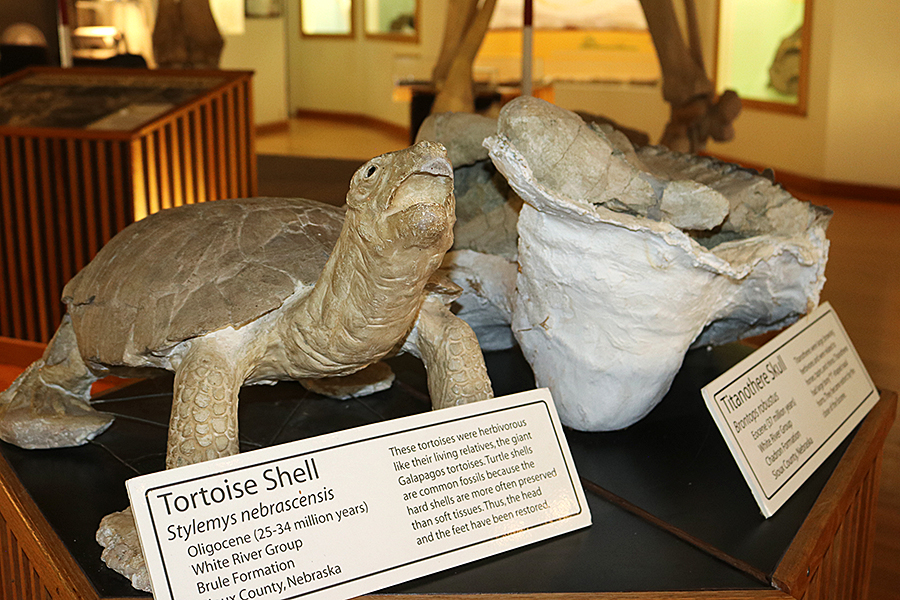
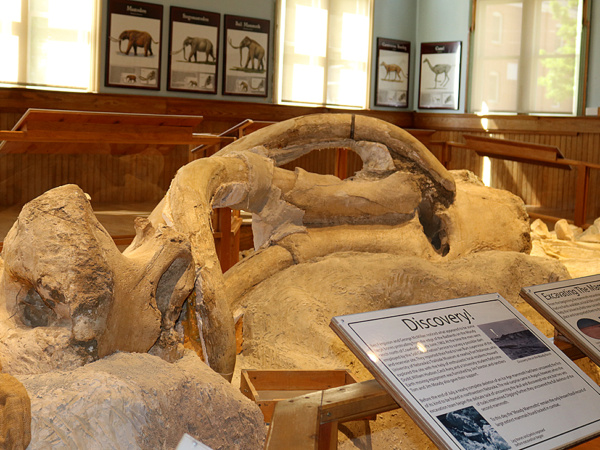
While the museum features exhibits ranging from invertebrate fossils and ammonites to examples of prehistoric marine and land reptiles, arguably the most popular exhibit is “Clash of the Mammoths.”
The fossils of two Columbian mammoths locked together in battle were discovered by Ben Ferguson and George McMillan in 1962 as the Soil Conservation employees were surveying an area for a dam on Dirty Creek. Ferguson and McMillan reported their discovery to staff at Trailside, allowing staff and students to begin the excavation project. Initially, researchers believed they were uncovering the remains of a single mammoth, but the find took on more importance when field crews realized there were two complete skeletons entwined at the tusks.
“Nothing in the fossil world had ever been found this way,” said Mark Harris, former associate director of the NU State Museum, in a 2012 interview with The Chadron Record.
“The Crawford mammoths are extremely unique,” said Shane Tucker, who works in the museum’s vertebrate paleontology department. “It’s actively preserving the behavior of the mammoths. Here we have a whole story about how these two animals ended up dying.”
The museum system has four tusks in its collection from two other mammoths that died intertwined but the rest of the skeletal remains had decayed, Tucker added. Researchers believe the Crawford mammoths died near the end of spring, during the musk, but don’t have an exact age of the fossils, he continued.
The mammoths were transported to the University of Nebraska-Lincoln after the excavation was complete, where they were housed in the museum system’s closed collections for the next 43 years.
Their return to Trailside Museum was facilitated by a group of local residents interested in exhibiting the Clash of the Mammoths in their Northwest Nebraska home. The Prehistoric Prairies Discovery Committee was formed as a partnership with the U.S. Forest Service as an effort to construct a new museum to house the mammoths, said Rosemary Petersen, a long-time volunteer with the group.
The U.S. Forest Service donated land adjacent to Fort Robinson State Park and commissioned blueprints for what they hoped would become the Prehistoric Prairies Discovery Center. The group conducted local fundraisers and lobbied the Nebraska Legislature for funding. Eventually, PPDC realized securing funding to construct a new museum was beyond its reach and the group shifted its goal to helping the University system renovate Trailside Museum as a suitable home for the mammoths.


They hosted a Mammoth Walk from Crawford to Fort Robinson State Park each year to raise funds and promote the idea of bringing the mammoths home.
“It was amazing. Kids went out and got pledges to earn prizes. We raised a lot of money with that Mammoth Walk and designed a new t-shirt every year with ‘Bring the Mammoths Back,’” Petersen said.
PPDC at one point secured grant funding to support an office and an employee in Crawford to work on the project of returning the Clash of the Mammoths to Northwest Nebraska. Work on the Trailside Museum included renovations to the former stage area of the building with the assistance of the Pine Ridge Job Corps and the installation of a sprinkler system to protect the valuable fossils, said Patricia Norman, who has worked at the museum since 2010.
Still, it wasn’t until 2005 that the Clash of the Mammoths exhibit was installed at the Trailside Museum.
“We were delighted (to learn they were returning),” Petersen said. “We earned it. It’s a one-of-a-kind find, and we’re proud to have it displayed. It was a project well worth working on.”
PPDC has continued to assist the museum since that time, and in recent years changed its mission statement to aid other Northwest Nebraska facilities dedicated to preserving and showcasing the region’s geologic record. A $5,000 effort to create new outdoor interpretive signage at Hudson Meng Bison Bonebed was another major project for the group. PPDC voted to dissolve earlier this year, however, donating its final $11,000 of funding to Trailside Museum.
“What they’ve done for the museum is just fabulous,” Norman said. “(They’ve helped) turn it into a real interesting place.”
For more information about Trailside Museum, visit https://trailside.unl.edu/.
By Kerri Rempp
Discover Northwest Nebraska
“Lots of rumors today that the Russians are getting very close. Hope it’s true.”
-Clayton Skoda, POW
Jan. 29, 1945
Seventy-five years ago, Rushville native Clayton Skoda wrote those words in a diary he kept as a World War II prisoner of war awaiting liberation. The Russians reached his POW camp days later, making it possible for him and his fellow soldiers to make their way home, and eight months later World War II came to an end.
Copies of Skoda’s diary, now on display at the Mari Sandoz High Plains Heritage Center in Chadron as part of the “Soldiering Into Victory” exhibit, detail his time as a prisoner of war.
Sept. 4, 1944: Moved on that morning, traveled all day till we got to Belfort. Was hauled all over town as the Germans seemed to be looking for some Headquarters of theirs. We stopped on the street for awhile and soon several of the French noticed that we were Americans, and they were giving us all sorts of fruit, bread and cigarettes. The Germans started chasing them away at the point of a bayonet.
Sept. 26, 1944: Was given a loaf of bread and a parcel for two men and loaded on the train to be sent to a NCO POW camp. They put 35 of us in about 1/3 of the car and the German guards had the other 2/3 of the car. It was so crowded that every one was in misery most of time.


Sept. 30, 1944: We found out our rations would consist of a cup of coffee or tea in the morning, mess gear of soup at noon, tea or coffee in the evening and six men on a loaf of bread every day except Sunday and Wednesday, when it was five on a loaf. We lived like that without any smokes until October 17th when we were issued our first food parcel. I hope I never have to eat that little amount or do without smokes that long again as it was really hell.
As the advancing Allied forces drew closer to the POW camp, Skoda noted in his diary that they were no longer allowed to use lights at night as the front lines were too close and a lack of coal meant no cooking.
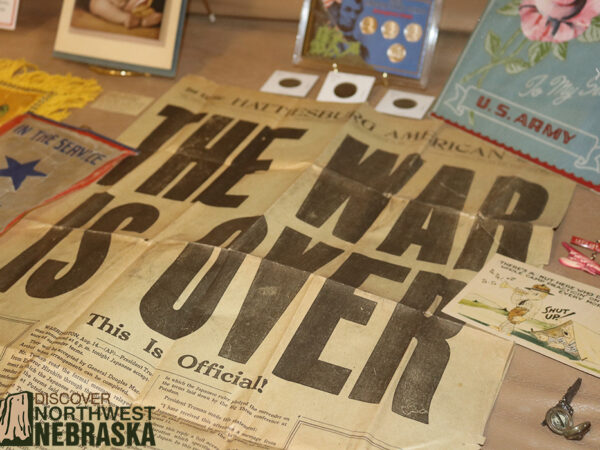
The Sandoz Center’s “Soldiering Into Victory” exhibit commemorates the 75th anniversary of the end of World War II Sept. 2, 1945.
“It is primarily looking at Nebraska and the surrounding area and its involvement in World War II,” said Holly Counts. The exhibit will remain on display through the summer.

Counts cultivated the exhibit from three major collectors – Mark Hunt, Tony Bestwick and Roger Coleman – and augmented it with pieces loaned to the Sandoz Center from local families. The exhibit details moments of World War II from the trenches and POW camps to the home front. Uniform ribbons line a glass case and sweetheart pins and pillowcases are showcased alongside ration books and military patches. One display case houses items brought home by returning soldiers, including trench art, captured flags and foreign currency, while across the room WWII-era uniforms from the Army, Marines, Army Air Force and Navy are arranged.
Telegrams to Anna Moffatt carrying the news that her son Clarence was a prisoner of war hang beside letters donated by Barb Pelton Nixon, mementos saved from her two brothers’ time serving overseas. Another soldier, Paul Kreitman, made notes on a paper lunch bag detailing his experiences for his fiancé.
“Participated in operations against Japanese forces at Saipan and Guam and against enemy air action during the assault and occupation of these islands,” he wrote.
Skoda, who was drafted Feb. 22, 1942, was assigned to the 117th Reconnaissance Group and was shipped to England, North Africa, Italy and France, where his captain surrendered the group to the 11th German Panzer Division. He spent five months at the Stalag3C POW camp in Kustrine, Germany, before he and his fellow soldiers were liberated by the Russians Jan. 31, 1945. The notes in his diary recall the day.
Were awakened at 4 o’clock this morning and told to pack all our stuff as we are going to be moved out of here at 7 o’clock. Started to move us at 7 o’clock but the boys in the other compound are giving them a hard time. They get them out of one room and they run into another room. Jerry finally got things under control and started us out of the camp. Got down the road about 3 miles and were fired on by machine guns and shell fire from Russian guns. Several of our boys were wounded and some killed and a good many were cut off. Russians found out who we were so held their fire. Were taken back to the camp and was everyone happy to know we were cut off. Was back in camp only a half hour when we got bad news that they were going to try and take us out a new way. Started out and got on the edge of camp when the Russians fired again. We all took off and went back in the compound and took for the air raid shelters. In about an hour the Russians took the camp with very little resistance from the Germans. Spent most of the night in the air raid shelter. That night was quiet but was afraid the Germans would throw in artillery.
The Mari Sandoz High Plains Heritage Center is open Monday through Thursday from 10 a.m. to noon and 1-4 p.m. and from 10 a.m. to noon on Fridays. The center is a 2020 Nebraska State Passport stop.

Juhlins open The Broken Spur in Crawford
By Kerri Rempp, Discover Northwest Nebraska Director
Northwest Nebraska might be the state’s best-kept secret, but for one family, once they discovered the region, they couldn’t get enough.
“To me this is Nebraska, the west, the prairies, the bluffs,” said Wally Juhlin. His family, including wife Jennifer and daughters Martina and McKenna, first explored the area as tourists several years ago and recently became residents and business owners after the purchase of a vacant restaurant building in downtown Crawford.

With renovations complete, their restaurant, The Broken Spur, opened several weeks ago with a limited menu and hosted grand opening festivities May 11.
“This is an entirely new adventure,” Jennifer said.
The family previously owned a plumbing, heating and air conditioning business in Walthill, Nebraska, but jumped at the chance to relocate to Northwest Nebraska when they learned the restaurant formerly known as both The Ranchhouse and Gate City was for sale.
Their first experience with the region was during a camping trip planned by Martina and McKenna several years ago.
“We drove 1,300 miles and never left the state,” Wally said. Northwest Nebraska, including Fort Robinson State Park, was one of their stops.
“We didn’t know this existed before that trip,” he said.
The next year, Martina returned as a wrangler at Fort Robinson, and eventually both girls enrolled at Chadron State College. Martina recently graduated with her art degree, while McKenna just finished her first year in pre-med at the college. Martina’s artwork is on display throughout the family business, from a large western-themed wall mural to portraits of John Wayne. She focuses on western and Native American themed portraits, so her work easily complements the environment the Juhlins want to create at The Broken Spur.

“This is cowboy country. We wanted this to be a western place,” Wally said.
That attitude translates to the food as well. When they set out on their new adventure, one of their primary goals was to build an establishment known for a good steak, large burgers and hearty meals in general.
“We want you to be full when you leave,” Wally said. “We try to make a meal like you make at home.”
From the aforementioned steak to half-pound burgers, pizzas and lunch specials, the Juhlins are creating an atmosphere that reminds visitors of home and family. Martina works as a bartender and hostess, while McKenna helps in the kitchen, making it a true family business in part of the state they all felt a pull to call home.
“It’s good for us to do something as a family,” McKenna said.
“We liked the area. We like the scenery. We love the people,” Wally added. “The entire community has welcomed us with open arms.”
The Broken Spur is currently open Tuesday through Saturday with plans to expand the menu and hours as the region recovers from the ongoing COVID-19 pandemic. The family also welcomes the opportunity to host wedding receptions, alumni reunions, holiday parties and more, Wally said.
“We want to be here for the local community, but we also want to be a stopping point for people traveling through,” Martina said. “No matter where you’re from, we want it to feel like family and home.”
By Kerri Rempp, Discover Northwest Nebraska Director
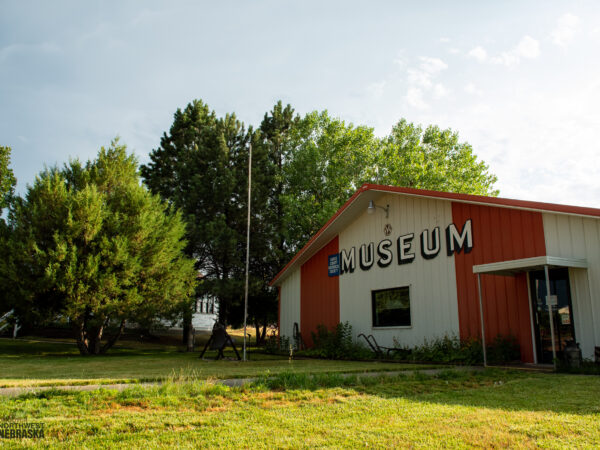
The Dawes County Historical Museum may be filled with antique artifacts, but the volunteers who run the museum are dedicated to bringing new exhibits to facility, and to finding new ways to display the artifacts entrusted to their care.
New to the museum this year are 18 “teaser exhibits” in the lobby, said curator Phyllis Carlson.
“They are mini-snippets of what you can see elsewhere in the museum,” she explained. Each building on the campus of the Dawes County Historical Museum south of Chadron is represented in the teaser exhibits, from photography and music to apparel and kitchenware.

On display for the first time is a collection of lightbulbs, including a nightlight and a bulb shaped like a rosebud. In the kitchen snapshot is a full bottle of olive oil. Atlases provide a look at old maps, and a nod to potato digging can also be found.
The teaser exhibits are housed along the west wall of the lobby, taking the place of the many books that once filled the shelves. The books have been relocated throughout the museum, adding depth to the facility’s other displays as train books now reside with the railroad exhibit and cookbooks with the kitchen display. Research volumes – more than 210,000 documents – are now together in one room, making them easier to access, and museum staff is working to create a card catalog for all of the documents and books.
With the teaser exhibits completed, the museum is turning its attention to the construction of a new building to house two new collections. Ground work for the construction is complete, and the goal is to have the building finished by the end of the year. The new building will be home to a doll collection donated by Richard and Clara Erixon and to Carl and Fawn Larsen’s collection of telephone company history.
Clara Erixson began her doll collection in the 1960s, and when the exhibit opens at the Dawes County Historical Museum roughly 3,000 dolls will be moved in to the new building, including antiques dating back to 1890. Erixson’s hobby eventually became a business when the couple opened Clara’s Attic on East Avon Street in Lincoln, restoring dolls, designing and sewing costumes for them and making her own dolls. The couple moved to Crawford in 1999.
Carl and Fawn Larsen moved to Chadron in 1966, and Carl, also a former Chadron mayor, worked for the telephone company for more than 50 years, collecting old phones, insulators, portraits, advertising signs, phone books and even an outdoor telephone booth along the way.


The museum is home to a pioneer schoolhouse and church and thousands of other items. Volunteers, of course, have their favorites.
“One of the things I get a kick out of is the surgical things,” Carlson said. She was 13 when she had her tonsils removed and remembers sitting in a surgical chair similar to the one they have on display as they deadened her throat and removed them. Showing that chair, as well as the gurney, incubator and other medical instruments to children always draws awed reactions, she said.
The Chadron-Chicago Horse Race exhibit is another favorite exhibit. On June 13, 1893, horseback riders set out from the Blaine Hotel in Chadron to traverse 1,000 miles to Chicago. The idea for the race began as a hoax, but soon turned to reality and Buffalo Bill Cody offered to sweeten the prize winnings for the first rider to arrive at the World’s Fair. The revolver won by Joe Gillespie, who won the race after two other riders were disqualified, is on display at the museum.
Assistant curator Linda Rotness is fascinated with the Marcus Cain exhibit. Housed in a building of its own, the collection features several unique pieces of farm equipment created by Dawes County farmer Marcus Cain.
“It’s so neat. You won’t find that anywhere else,” Rotness said.
Cain is believed to have developed one of the first self-propelled combines in existence in the 1930s, and other pieces of equipment on display include a 24-foot roto-tiller/grain drill/soil packer with three motors, a single-engine stubble chopper, customized grain trucks and a World War II tank retriever crawler tractor.
Visitors to the museum find their own favorites among the exhibits, but the common theme is amazement at just how many items the museum houses.
“They’re usually surprised at what we have,” Rotness said.
“They (also) appreciate that they can get close to the items,” Carlson added. “Everything is not behind glass.”
The Heesacker toy collection appeals to both children and adults, with toys of all decades on display.
“It’s like walking through your own memory,” Carlson said.
The variety of exhibits all but guarantees everyone will find something to interest them – whether it’s the agricultural equipment of Marcus Cain and the fashion and textile items on display to musical instruments or a collection of thousands of pens.
The museum was originally located in Chadron at 255 Mears St., but outgrew that location. A donation of land to the historical society made it possible for the museum to relocate to its present site in 1982, where it has continued to grow.
“There’s just all sorts of history here,” Carlson said.
The Dawes County Historical Museum draws 2,000-2,500 visitors annually, some of whom have long-ago connections to the region, and others, including visitors from overseas, who have no ties to the area. A relative of one of Chadron’s most prominent pioneer women, Fannie O’Linn, was so impressed with the museum they purchased a floor tile, Carlson said. The museum sells engraved floor tiles as a fundraiser, a tradition that has continued since the museum opened.
The museum’s other major fundraiser is the monthly publication of the Golden Age Courier. The free tabloid, first published in 1987, is filled with historical items of note, stories from local contributors and a few fun facts.
Many of the museum volunteers have been donating their time to the historical society’s efforts for years. Carlson and Rotness have worked with the museum for nearly a decade, with Carlson taking over as curator in 2013. While they upload obituaries to the computer, write the museum’s newsletter and maintain the society’s membership, the volunteers find camaraderie with each other.
“The first thing you’re going to hear is laughter,” Carlson said.
And with thousands of artifacts, there’s always something new to discover.
“No matter how long we work here, and it usually happens when we’re showing someone around, we notice something different,” Carlson said.
The museum hosts an annual Garden Party each August and History in Action Day on the last Sunday of September each year, giving guests more opportunities to view exhibits up close. The status for both of the 2020 events is yet to be determined due to the COVID-19 pandemic. The Dawes County Historical Museum is typically open from Memorial Day through the last Sunday of September, or by appointment. Due to the COVID-19 pandemic, the museum is currently open only by appointment. Call 308-432-4999 or email dchsdirector@gmail.com. Masks and the use of hand sanitizer will be required during your visit.
Fellows will join CSC intern in promoting region
By Kerri Rempp, Discover Northwest Nebraska Director
Discover Northwest Nebraska is partnering with Chadron Public Schools and Educational Service Unit 13 to host two interns from the Rural Futures Institute this summer after the Chadron community’s success with RFI Fellows last year.
Chadron Public Schools hosted three interns in 2019, where the students focused their efforts on mental health awareness. The 2020 interns will devote approximately 40% of their time in Chadron working with Discover Northwest Nebraska to further develop tourism in the region.
“Tourism is an important economic driver in Dawes County and Northwest Nebraska,” said Director Kerri Rempp. “The recent COVID-19 pandemic has already and will continue to disrupt the 2020 tourism season for the region. Having interns available for the summer will allow us to focus on promoting local and regional tourism through staycations and complete several planning projects to put us in a good position for 2021.”
Tyra Ann Reardon and Sawyer Smith have been assigned to Chadron through RFI Fellows program. Reardon is a senior at the University of Nebraska-Lincoln, while Smith is a sophomore at UNL. This year’s internship program will last eight weeks.
The interns are required to provide 10 hours of community service and also will complete coaching sessions to earn their Inclusive Leadership Development Certificate.
“A hybrid between service learning and traditional internships, RFI Fellows experiences provide communities with tangible results on important self-defined projects while giving students resume-building work and insight into the career and life opportunities in rural places,” the Rural Futures Institute website reads. “In this unique experience, student pairs directly support community efforts as a whole, often serving as the link between many entities.”
Reardon and Smith will be mentored by leaders from each of the partnering organizations. Terri Haynes and Sandy Montague-Roes will oversee the students’ work on the mental health initiatives. Rempp will mentor the students for Discover Northwest Nebraska while Dr. Katherine Carrizales will do so for ESU 13.
The RFI Fellows will join Chadron State College intern Brandon Davenport in the development of programs and marketing campaigns designed to enhance the tourism industry in Northwest Nebraska. Davenport is majoring in journalism and plans to graduate in December.
“Having three interns available this summer will allow Discover Northwest Nebraska to move forward with several items I would like to see accomplished and in a much faster time frame than would be possible without their efforts. It will also provide all three interns with valuable work experience and a boots-on-the-ground look at destination marketing,” Rempp said.
Discover Northwest Nebraska will launch a social media challenge March 30 in an effort to show support to local businesses as they work to meet your needs in these uncertain times.
As the State of Nebraska continues to monitor the spread of COVID-19, many Northwest Nebraska businesses in Dawes and Sioux counties have changed their hours or business delivery models to follow the recommended guidelines issued by the CDC. Starting March 30, Discover Northwest Nebraska is urging residents and visitors to the region to show their support for local businesses and have a bit of fun with Northwest Nebraska Bingo, all while following current CDC recommendations.
“Our regional businesses have stepped up to continue to provide much-needed services during the ongoing pandemic. Supporting local business is always the right thing to do for the area’s economy, but as the current situation continues, our community can re-double its efforts and help our local businesses sustain themselves until things return to normal,” said Discover Northwest Nebraska Director Kerri Rempp. “The launch of the Northwest Nebraska Bingo challenge brings a bit of fun into doing what’s right, and we hope to continue the challenge throughout the summer as we encourage staycations and regional tourism. Details on Northwest Nebraska Bingo after April 30 will be released as they become available.”
Northwest Nebraska Bingo is easy to play. Between March 30 and April 30, find the Northwest Nebraska Bingo card on one of Northwest Nebraska’s social media accounts (Facebook, Instagram, Twitter and Linked In). Over the course of the month, take a photo of yourself or your family completing all of the actions on the card at eight different Dawes or Sioux county businesses. Share the photos on Facebook or Instagram using the hashtag #NWNebraskaBingo. Once you’ve completed your card and posted all of your photos, send your name, address, email and social media handle (for the account you posted your photos to) to director@discovernwnebraska.com. Everyone who completes a Bingo Card in its entirety will be entered to win one of three giveaways of $50 in Chadron and Crawford Chamber Bucks.
Printed Bingo cards will also be available at the Chadron Chamber of Commerce & Visitors Bureau, and photos can be emailed to the address above for participants who do not have social media accounts. The challenge will end at 11:59 p.m. MT April 30, 2020.
By Kerri Rempp, Discover Northwest Nebraska Director
Northwest Nebraska may not be the art mecca of the world, but there are plenty of talented regional artists creating unique pieces of work, and with the opening of the White River Gallery a few years ago, those artists now have a space to display and sell their creations.
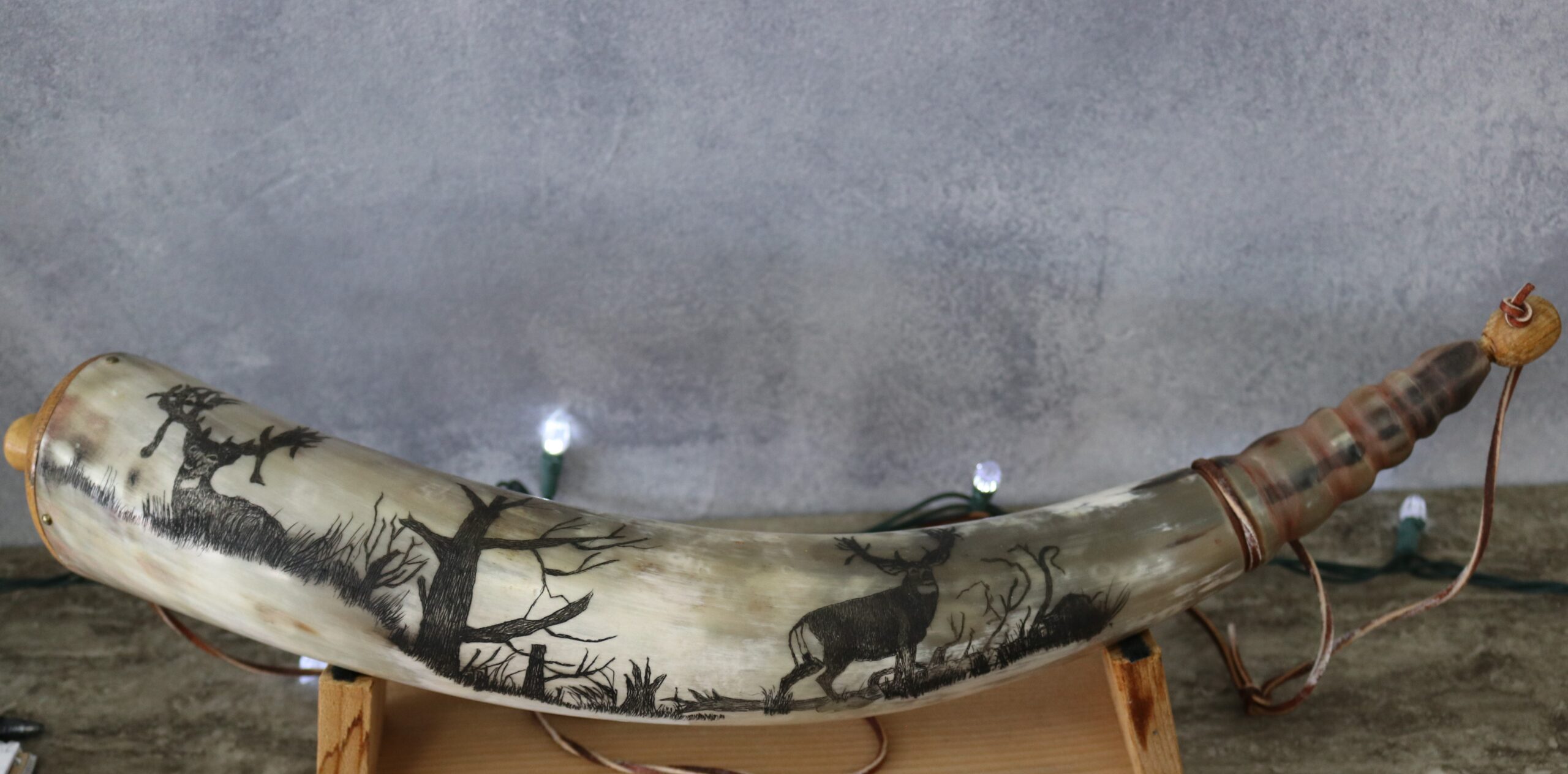
Enter White River Gallery on Second Street in Crawford and you’ll have your pick of pottery, acrylic and watercolor paintings, photography, handmade jewelry, scrimshaw powder horns and even homemade books.
“I have a lot of pieces with wildlife and western themes,” said owner Clarice Hynes. “I don’t limit the work to that motif but a lot of it ends up being that.”
Hynes and her husband, John, moved to the region 10 years ago after he retired from the Air National Guard and joined Burlington Northern Santa Fe as a conductor based out of Edgemont, S.D. When BNSF furloughed employees, he went to work at Fort Robinson while she was employed at Head Start in Chadron. Preferring not to commute to Edgemont when BNSF brought its employees back, they chose to settle in Crawford and pursue other endeavors.
The White River Gallery grew out of a desire to rent a separate space to serve as Hynes’ art studio since their small home limited her ability to focus on her craft. A life-long lover of art and a retired K-12 art teacher, whose own creations often took a backseat to raising children and teaching, Hynes wanted to rededicate herself to her art.
“Now, I’ve got all this time and space and there should be no reason to go great guns.” Hynes said. “Mostly I do watercolors, and I tend to paint mostly landscapes.”


Initially, they planned to rent a studio space but eventually decided to purchase a 1940s-era building in downtown Crawford and renovate the space for her studio. Opened as a bakery seven decades ago, the building had also served as a flower shop, a gift shop and, most recently, a pizzeria. The couple did the renovations themselves over the next 18 months and opened in March 2017.
“A lot had to be changed because it wasn’t going to be a restaurant anymore,” Hynes said. “Each occupant added their own flair to the place, and I guess we have done the same, keeping some elements of the building’s history where we could by reusing and repurposing materials while uncovering some of the original features of the structure, including the class block, pigmented structural glass panels (vitrolite or carrara glass), some of which we were able to save,” she adds on her website.
As the project progressed, the purchase and renovation of the building evolved from creating a studio for Hynes to establishing a full-fledged gallery to capitalize on the available space. Regional artists were excited to have the opportunity to display and sell their work.


“There are not many places to show your work if you’re an artist in this neck of the woods,” Hynes said.
According to her website, White River Gallery currently exhibits the work of 13 artists, including Hynes’ watercolor and acrylic creations, handmade books and paper. Other work featured at the gallery are J.W. Kelly’s prints and photography, Theresa Young’s photography, Joel Hanlon’s scrimshaw powder horns, Linda Dabbs’ pottery, painting, interior design and outdoor art, Michaela Hynes’ acrylic and phosphorescent paintings and graphic design and John Hynes’ photography and woodworking. But the list doesn’t end there. Lisa Farrington’s watercolor, pen and ink creations and leaf assemblage are showcased, as is Jean Dupree’s handmade jewelry. Photography by Deborah Horst and paintings and bronze sculptures by Vern Friesen can often be found, as can photos, drawings and paintings by Chris Hynes and various media and prints by Jean Norman.
Hynes said she’s been able to maintain a stable population of artists, providing the opportunity for residents and visitors to purchase unique pieces.
“Everyone who comes in has complimented me on how nice it looks and the variety of the artwork,” Hynes said, adding that beyond selling artwork she’s pleased to offer a place where people can simply come in, enjoy the artwork and take a relaxing break from the world.
Budding artists of all ages can also practice their skills and get tips by taking one of the gallery’s classes, ranging from booking making for adults to the subtleties of shades and tints for kids. Hynes even offers art birthday parties for kids and adults, and makes the gallery available as a meeting space.
“It is primarily a place for me to work and show my art, but also we hoped it would be a good addition to the community. None of it would have happened without John’s vision and craftsmanship. He loved to design, and build and work out problems. Thinking back on it, the gallery was simply another in a long line of projects, though certainly much larger in scale, it was what he always did, and I’m forever grateful to him,” she said.

By Kerri Rempp, Discover Northwest Nebraska Director
Two events traditionally held in separate counties are merging in 2020 and making Chadron their new home. The Harvest Moon Fall Festival, an annual event in Hemingford, plans to relocate this fall as the event continues to grow and will merge with Chadron’s annual Harvest Fest into one larger event.
“There’s a lot of excitement for us going to Chadron,” said Harvest Moon Festival organizer Julie Lawrence. She began the event eight years ago with a friend as a day-long craft show with other events and contests to create a family friendly atmosphere. The Harvest Moon Fall Festival has become a staple fall event, drawing around 3,000 attendees, Lawrence said.

With the potential for additional growth and challenges presented by weather, Lawrence and the other organizers began to scout new locations to accommodate the growth and provide additional options in less than ideal weather.
“Dawes County graciously opened their arms,” Lawrence said.
With a second harvest-themed event arriving, the Chadron Chamber of Commerce decided to join forces with Harvest Moon rather than hosting its annual Harvest Fest. Details of exactly how the two events will merge are still being determined, said Chamber Director Gabby Michna.
The relocation to Chadron and combining forces with the Chamber’s event opens up new opportunities for Harvest Moon, Lawrence said, noting that she hopes to include the college and the National Guard in the event.
Harvest Moon serves as a fundraising event for local non-profits, with various organizations operating booths and keeping their profits. The Chadron Washington, D.C. Kids, for example, has already signed up as a vendor to sell meaty nachos to raise funds for their trip. Lawrence also encourages local school musical groups and dance groups to perform as a way to make connections with the wider community.
The Harvest Moon Fall Festival is a family-focused event, with a pumpkin decorating booth, a Farmer’s Market, a kids’ costume contest, a chili contest, live entertainment, goat roping and more. Vendors from South Dakota, Colorado, Wyoming and eastern Nebraska typically take part, and Lawrence hopes the move to Chadron will expand that reach. Admission is free, and a beer garden hosted by the Dawes County Ag Society will screen the Husker game and serve as the spot for the beer and wine contest.
“It’s always been a good event,” Lawrence said. “It’s refreshing to see the excitement.”
The Harvest Moon Fall Festival is scheduled for Oct. 3 from 9 a.m. to 5 p.m. at the Dawes County Fairgrounds. Non-profits and other vendors interested in participating can email Lawrence at lawrenceadventures@yahoo.com or visit harvestmoonfallfestival.com and fill out the contact form.
This summer, travelers celebrated the Nebraska Passport Program’s 10th anniversary by touring the state and collecting stamps in record breaking numbers. This year, 909 participants submitted Passports with all 70 stops stamped, versus 769 in 2018 and 469 in 2017. These “Passport Champions” hail from Colorado, Florida, Indiana, Iowa, Kansas, Missouri, Nebraska, Oklahoma, Oregon and Washington.
“Over the 2019 Passport season, I heard so many wonderful stories from our participants. Ranging from someone who takes their 98-year-old grandma around Nebraska every year to how a young boy begs his mom to take him back to Springfield Drug because he loved their milkshakes so much,” said Madison Schlake, Passport Program Coordinator. “Almost every day I was flooded with stories of family, friendship and genuine love for our beautiful state. Our “Passporters” are what makes this program so successful.”
2019 Nebraska Passport Statistics:
“I’m not a native Nebraskan, so I’ve been able to use the Passport Program to help me explore the state in the three years that I’ve been here. This year I made it to 51 stops!” said John Ricks, Nebraska Tourism Commission executive director. “This program has continued to grow and every year it’s exciting to see how many people in Nebraska are exploring the state beyond their backyard.”
In 2017, the Nebraska Passport program generated nearly $6 million in travel spending throughout the state and $469,500 in state and local tax revenue, according to a study done by Dean Runyan & Associates.
Be a 2020 Nebraska Passport Stop
Not only does the Nebraska Passport program benefit travelers through helping them create life-long memories, the program greatly benefits the 70 chosen Passport stops through increased traffic, sales and awareness.
Applications are now being accepted for Nebraska Tourism’s 2020 Passport program. Any Nebraska destination is welcome to apply to become a Passport stop. Past stops have included museums, restaurants, outdoor adventures, retail stores, etc.
To complete the 2020 Passport online application, as well as to view information about Passport stop requirements, how the program benefits Passport stops, and details about the application process, go to: http://nebraskapassport.com/passport-details/application/. The application deadline is December 31, 2019. Questions about participating in the program can be directed to info@nebraskapassport.com
The Dawes and Sioux County Travel Boards are each accepting applications for improvement grants to enhance visitor attractions in both counties.
Applications will be reviewed by each board in January, and interested public and non-profit entities are encouraged to begin the application process now. Attractions must apply for the improvement grant in their respective county only.
Improvement grant funds are available to expand or improve existing visitor attractions, acquire or expand exhibits or construct visitor attractions. The grants are funded by the proceeds of a lodging tax on motel/hotel/campground lodging in Dawes and Sioux counties, as authorized under the Nebraska Visitors Development Act.
“We are continuing to see increased interest in Northwest Nebraska, and improved attractions will allow us to build on that momentum,” said Northwest Nebraska Tourism Director Kerri Rempp.
Dawes County applications are due Dec. 27, and Sioux County applications are due Jan. 1, 2020. Applications and a complete list of guidelines can be found at DiscoverNWNebraska.com.
Each county also offers promotional grants to assist with advertising, signage and other promotional materials. The Dawes County Travel Board reviews applications for promotional grants each month; Sioux County accepts those grant applications on Jan. 1, April 1 and Oct. 1. Visit Discover NWNebraska.com or call 308-432-3006 for more information.

